Speaker: Cheng Qunfeng, Professor, School of Chemistry, Beihang University
Time: November 19, 2024, 9:30
Venue: Conference Room 308, 17th Floor, Laboratory (School of Mechanics)
Brief introduction to the report:
The Development Outline of Green Aviation Manufacturing Industry (2023-2035) jointly issued by the Ministry of Industry and Information Technology and the Ministry of Science and Technology points out that the development of green aviation manufacturing industry is an inevitable requirement to cope with climate change and achieve sustainable development of the aviation industry. Among them, lightweight materials are one of the key core technologies for the development of green aviation. At present, Boeing, Airbus, C919 passenger aircraft a large number of carbon fiber composite materials, to achieve weight reduction and energy conservation and emission reduction. Compared with carbon fiber, two-dimensional nanomaterials (graphene, titanium carbide, etc.) have more excellent mechanical and electrical properties. The use of two-dimensional nanomaterials to construct high-performance nanocomposites is an effective way to solve the bottleneck problem of aircraft lightweight in the aerospace field, and has important national defense, military and other strategic significance and economic value. However, the mechanical properties of nanocomposites are much lower than expected and their repeatability is poor, which limits their practical application. In response to the above bottleneck problems, we found the key scientific problems to improve the performance of nanocomposites, developed a limited assembly strategy for green and low-carbon manufacturing of nanocomposites, obtained original research results, and provided theoretical guidance and technical support for the creation of high-performance nanocomposites.
Key words: Bionics, confined assembly, mechanical properties, two-dimensional nanomaterials
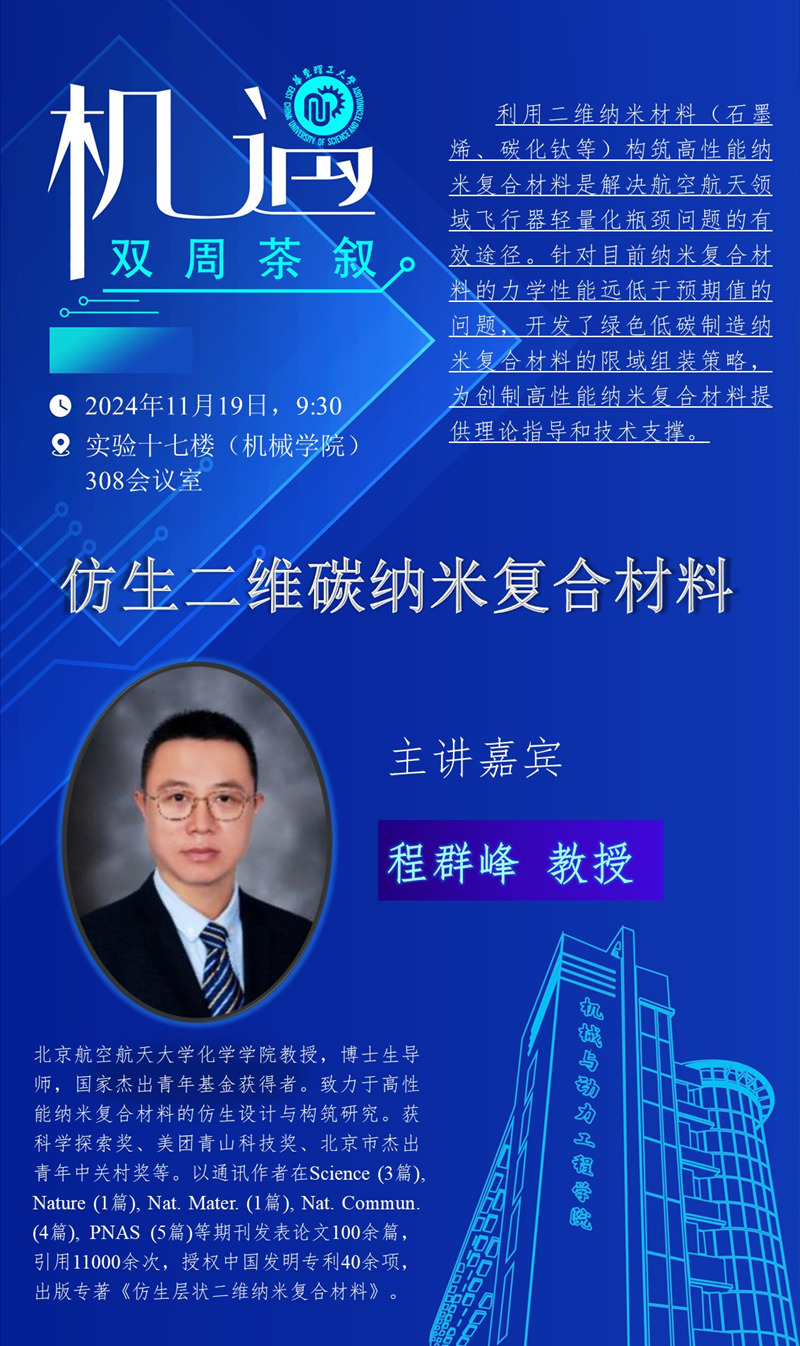
Cheng Qunfeng, professor, doctoral supervisor, School of Chemistry, Beijing University of Aeronautics and Astronautics, winner of the National Outstanding Youth Fund. He is committed to the bionic design and construction of high-performance nanocomposites, found the key scientific issues to improve the performance of nanocomposites, developed a new strategy for green and low-carbon manufacturing of nanocomposites, created high-performance nanocomposites, achieved original results, and laid a theoretical foundation for its application. He has won Scientific Exploration Award, Meituan Qingshan Science and Technology Award, Beijing Outstanding Youth Zhongguancun Award, MAO Yisheng Beijing Youth Science and Technology Award, China Chemical Society Youth Chemistry Award, etc. He served as executive deputy Director of Nanocomposites Branch of China Composite Materials Society; Editorial board member of Chinese Chemical Letters, Biomaterials Advances, Giant and other journals. As the corresponding author, he has published more than 100 papers in Science (3), Nature (1), Nat.Mater. (1), Nat.Commun. (4), PNAS (5) and other journals, citing more than 11,000 times. He has authorized more than 40 Chinese invention patents and published a monograph Bionic Layered two-dimensional Nanocomposites.